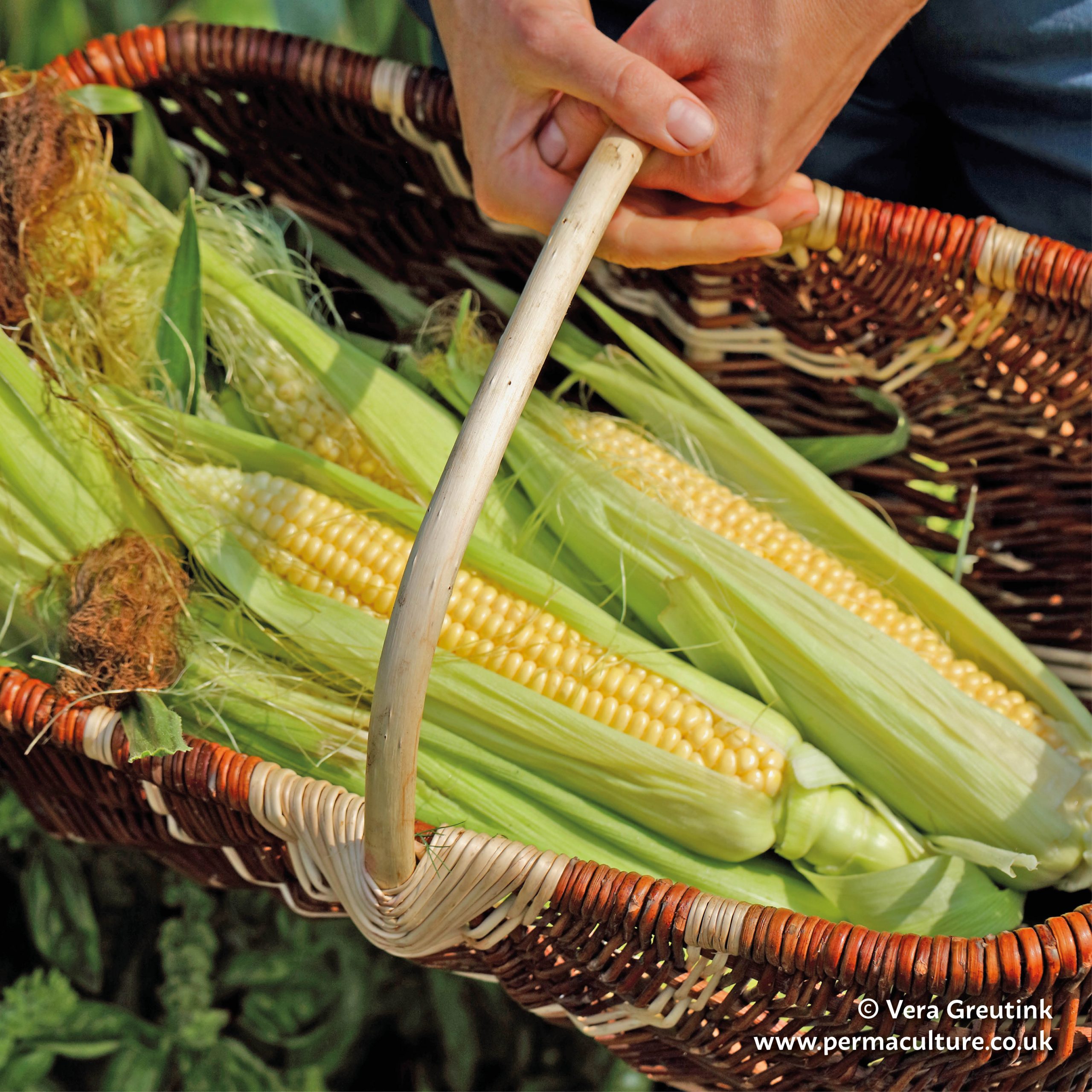
Is corn a veg or a grain? The answer will differ from country to country and even from person to person, but it’s actually both. It depends mostly on what variety you choose to grow, when you harvest and how you use it. Corn originated in Central America and has been a diet staple in the region for thousands of years. In this case it means flint corn or flour corn, corn rich in starch that doesn’t have an overly sweet taste and is dried and ground into flour. Other countries prefer the taste and high sugar content of sweet corn and use it as a vegetable. Fortunately, as a gardener, you can grow them all: Flint corn, flour corn, sweet corn or popcorn are all fun to try.
According to American folk wisdom, the best moment to sow corn is when oak leaves are ‘the size of a squirrel’s ear’. Instead of monitoring oak trees, I usually just monitor the calendar and do my first sowing on the windowsill during the second half of April (USDA Hardiness Zone 7-8).
I like to sow corn in extra deep pots, such as rootrainers, since these give the plants enough room to develop strong roots. The seedlings grow fast and can usually be planted out two to three weeks later. To spread my harvest over a longer period of time, I sow once or twice more through May and early June. By then the ground has warmed up, it is possible to sow directly outside, but to avoid birds or mice eating the seeds I still prefer to presow in a safe spot.
Even though corn germinates best at warm temperatures, it can tolerate somewhat lower temperatures later on. I once unintentionally tested this when we went away for a week at the beginning of May. Because there was nobody to care for my seedlings, I decided to plant them out early. Even though the weather turned cold and rainy, the plants were fine.
Sweet corn requires fertile soil, but flour corn is a little less demanding and can also tolerate more drought. However, all types of corn need sufficient water when pollination occurs and when the kernels are swelling. If there’s no rain and you do not water, it might mean that (some of) the kernels will not develop.
Another possible reason for poorly filled ears is insufficient pollination. On every plant, there are both female flowers (‘ears’ on which kernels will develop) and male flowers (the tassels on top of the plant). Unlike in most other vegetables, the pollen is mainly transferred not by insects, but by wind. Planting corn in a single row can lead to poor pollination, so it’s better to plant in groups or blocks of at least nine plants or several rows next to each other. Pollination by wind also means that pollen can be transferred over quite some distance (sometimes even hundreds of feet) and if your sweet corn gets pollinated by, for example field corn, the taste will be negatively impacted.
Supersweet corn will even become less sweet if it gets pollinated by traditional sweet corn varieties. I often grow several types of corn in my garden, so I try to ensure that they will not flower at the same time by sowing them a couple of weeks apart.
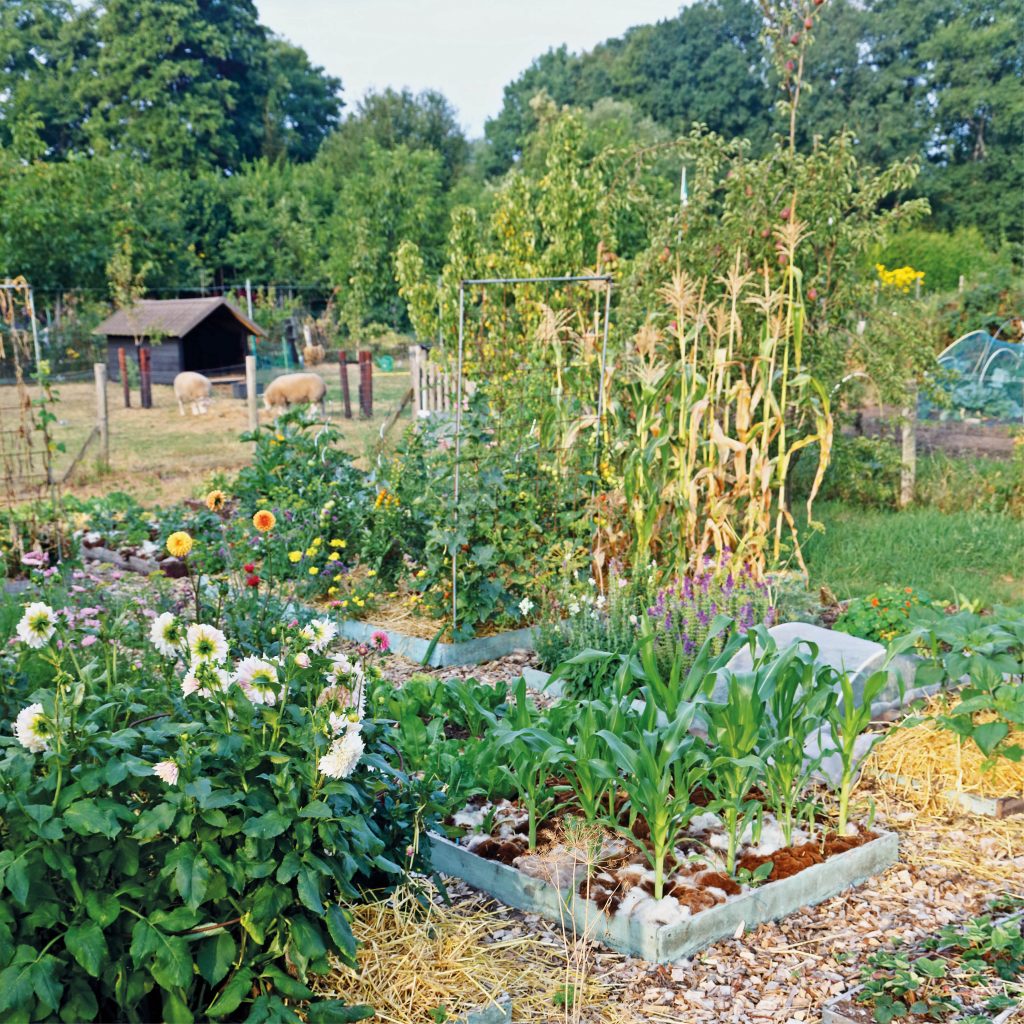
A good average distance between plants is around 1 foot/30cm in both directions. My raised beds are 4 feet/120cm wide, so I usually plant four rows with four plants in each row. Since I always strive to use my garden beds as efficiently as possible, I like to combine corn with other veg. Here are three suggestions:
Corn + Chard
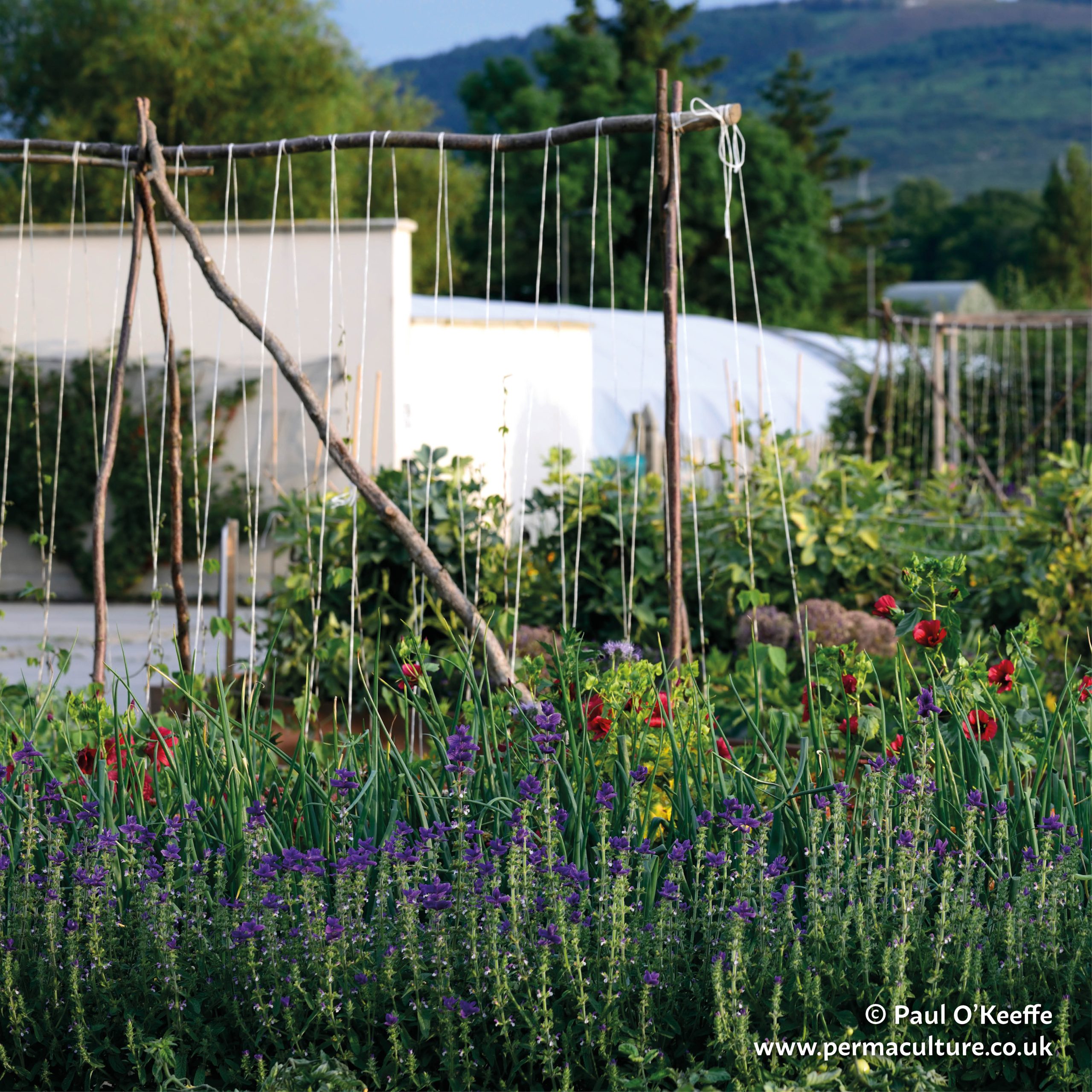
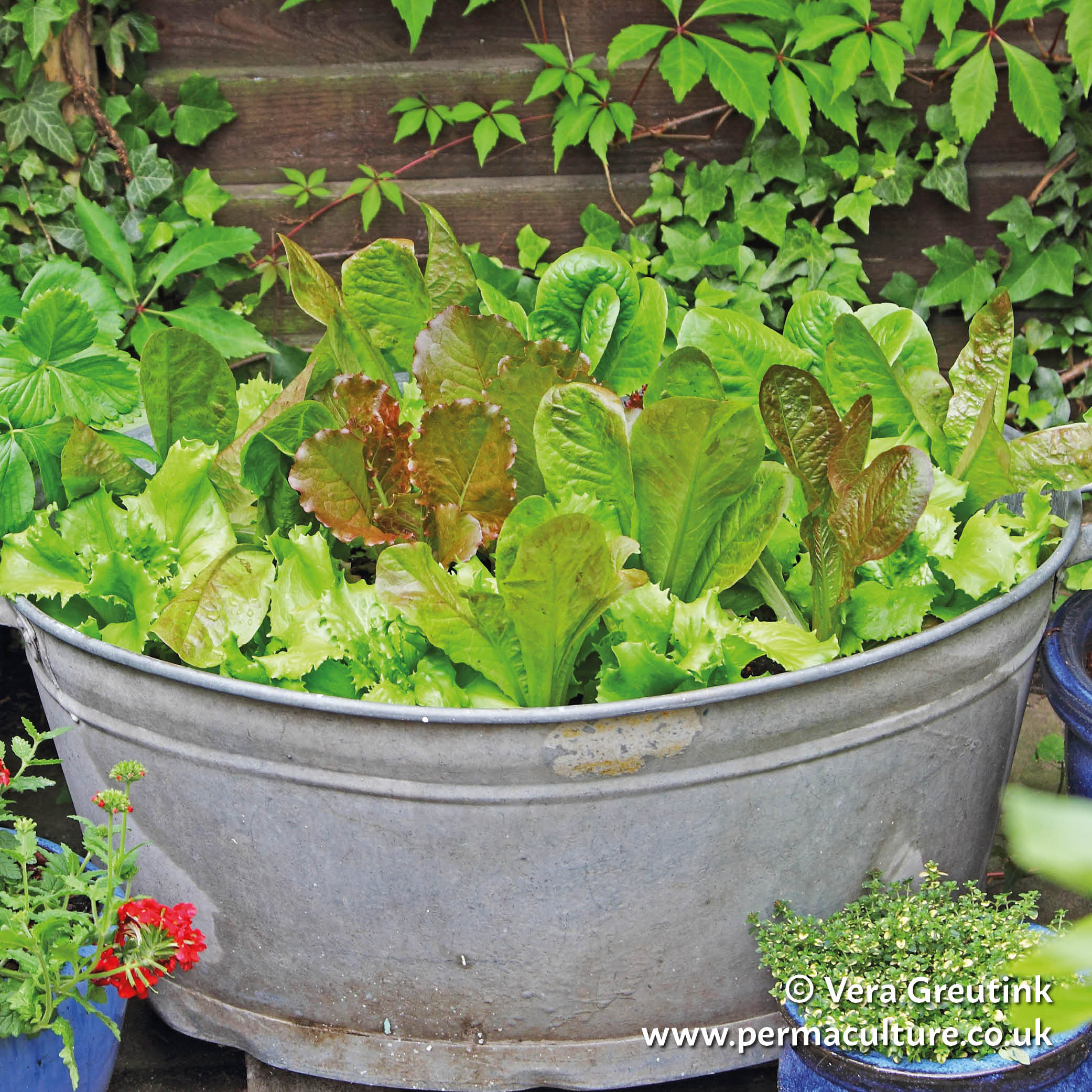
I like to underplant the tall and slim corn with leafy veggies that grow closer to the ground, such as lettuce or chard. During the summer, both of these leafy vegetables appreciate the part shade under the corn, but since chard has a longer growing season it will continue growing even after the corn has been harvested. After I harvest the ears, I cut the corn stalks close to the ground, so that during autumn the chard gets more sunlight.
Corn + Beans
The sturdy stalks of corn work well as support for climbing beans. I plant the corn first and wait till the plants are around 15-20cm tall. Then I sow two beans at the foot of every corn plant. The harvest of beans in this case is definitely smaller than if you had grown them separately and they’d get more sunlight, but I see it as a nice bonus. You can also space the corn further apart (40cm) so that the beans get more light, in which case you’ll harvest more beans but less corn.
Corn + Ice plant
The succulent, slightly salty tasting leaves of ice plant (Mesembryanthemum crystallinum) are one of my favourite summer salad ingredients. Ice plant is also an excellent edible ground cover and just like corn, it grows best during the summer. I sow it inside in April and plant it out together with the corn, or a little later. It spreads and covers the ground in between the corn plants, not only giving me an extra harvest but also functioning as a living mulch, preventing weed growth and slowing down evaporation.
Several years ago I planted a Mexican polyculture in one of my beds that featured all kinds of edible plants from Central America, including tomatillos, sunflowers, chilli peppers, zinnias and, of course, corn. I chose the beautiful multicoloured variety ‘Painted Mountain’ which I later dried and ground into flour (for a more detailed description of this polyculture please refer to my book Edible Paradise). Even prettier is the variety ‘Glass Gem’, the colourful kernels of which resemble glass beads and which I have used as popcorn.
Most gardeners will probably be primarily interested in growing sweet corn, but even within this category, there are different types to consider. Here are some that I have grown in my garden.
Traditional open-pollinated sweet corn
The sugar gene (SU) is what gives these varieties the high sugar content in the endosperm. The kernels are delicious, sweet and creamy, but only if you harvest them at the right moment and eat them right away because after harvest, the sugar immediately starts turning to starch.
‘Golden Bantam’ is a reliable mid-season ripening variety with large cobs, a classic among the traditional varieties.
‘Golden Midget’ – miniature (6 inch/15cm) cobs with yellow kernels on plants that are just around 3 feet/ 1 metre tall – an ideal variety for a children’s garden.
Supersweet corn
The shrunken gene (SH2) gives these varieties an even higher sugar content and it also considerably slows down the conversion into starch after harvest. This means the cobs can be stored for more than a week – a huge bonus for commercial growers. However, while the kernels are indeed super sweet and keep their sweetness longer, the texture is not as creamy as in traditional varieties. The plants also generally need more coddling and require higher temperatures. These two varieties are easier than most.
‘Damaun’ – this variety has been bred by the German organic seed company Sativa which means it is well-suited to organic growing in our North European climate.
‘Early Xtra Sweet F1’ – another extra early ripening variety with yellow cobs.
Tendersweet corn
This type of corn combines the desirable characteristics of the previous two: The kernels are extra sweet (although a little less than in supersweet corn) but they still have the creamy texture of the traditional varieties and do not become chewy. Another advantage is that you can grow them together with other types without the quality deteriorating through cross-pollination.
‘Lark F1’ – midseason ripening variety with pale yellow kernels. It will germinate and grow well even in somewhat lower temperatures. The plants grow to about 6 feet/2m tall.
Vera Greutink is an organic grower, author and writer. She is the author of Edible Paradise.
Living with the Earth: Volume 3 – Creating a Microfarm by Perrine Bulgheroni and Charles Hervé-Gruyer
Permaculture Planting Designs by Pippa Chapman
The Forager’s Garden by Anna Locke



No related articles to show for this tag

Vera Greutink is a permaculture gardener, teacher and designer based in the Netherlands. She’s been gardening for over 30 years during which she has created many beautiful and productive gardens